
Form builds the city. Life makes us love it.
Form gives a city its permanence; it is not what makes people attached to it. What the research says about screens, content and community — and why tech-first smart cities keep failing. (Cover Image: Projection on the Grande Bibliothèque, Quartier des Spectacles, Montréal. Photo: art_inthecity, CC BY 2.0, via Wikimedia Commons.)
Hassan Asgharian17 min read
Architects trained in the classical tradition tend to say that a city is made by its physical fabric: streets, squares, enclosure, the way a building meets the ground. They are mostly right, and it is worth saying so before arguing with them. A street grid outlives every screen bolted to it. People find their way by edges, nodes and landmarks, not by notifications. And the most expensive digital-city projects of the last decade have failed in ways that make the classical position look prudent.
The question here is narrower: is form enough? Is it what makes people attached to a place — and if not, what is the rest, and where do screens, content and community fit?
This is a longer summary of a working paper prepared for a gathering of Vancouver Persian Architects and FANNI BC in October 2026. The full paper, with its method, figures and complete references, is available as a PDF.
Three ways of explaining a city
The first tradition explains urban quality through form. Camillo Sitte's enclosed squares, Kevin Lynch's paths, edges and landmarks, Aldo Rossi's collective memory held in buildings and Christian Norberg-Schulz's genius loci all locate the character of a place in its physical shape.
The second says form matters only to the extent that it supports life. Jane Jacobs, Jan Gehl and William Whyte studied what people actually do in streets and plazas, and found that seating, sun, food and things to watch decide whether a space gets used. Whyte called one of these effects triangulation: an external stimulus — a busker, a sculpture — that gives strangers a reason to talk.
The third treats networks and media as part of urban space itself. Manuel Castells described a "space of flows" laid over the space of places; Lev Manovich called physical space overlaid with changing information "augmented space"; Martijn de Waal described the city as an interface. Alongside it runs a critical strand — Adam Greenfield, Shannon Mattern, Rob Kitchin — warning that smart-city technology often serves vendors and surveillance rather than residents.
Richard Sennett gives the tension its cleanest form: the ville, the built city, and the cité, the lived one. Most arguments about future cities are really arguments about which of the two comes first.
None of these traditions is wrong. The useful question is how much each one explains.
What makes people attached to a place
The largest North American study of the question is the Knight Foundation and Gallup Soul of the Community project, which surveyed residents of 26 U.S. communities every year from 2008 to 2010. The same three factors predicted attachment each year:
- Social offerings — places to meet and things to do
- Openness — how welcoming a place is to different people
- Aesthetics — physical beauty and green space
Jobs, the local economy and basic services ranked well below them. Communities with higher attachment also tended to show higher local GDP growth — an association, not proof of cause.
Read against the three traditions, the result is structural. Form supplies aesthetics directly and makes social offerings possible. But social offerings depend on what happens in the space — programming, events, information — and openness depends on who decides and who is welcome. Form is one of the three, not all of them.
What people now expect from public space
Several strands of research point the same way.
- The experience economy. Joseph Pine and James Gilmore argued that economic value moves from goods and services towards staged experiences. Cities increasingly compete on what happens in them, not only on what they contain.
- The 15-minute city. Carlos Moreno and colleagues framed proximity and multi-use neighbourhoods as organising principles after the pandemic. A neighbourhood space is now expected to do several jobs, not one.
- Tactical urbanism. Mike Lydon and Anthony Garcia documented low-cost, temporary interventions as a route to permanent change — a direct precedent for reconfigurable, modular elements in public space.
- Smart-city potential, with a caveat. The McKinsey Global Institute estimated that digital urban applications could improve some quality-of-life indicators by 10–30%. These are modelled figures, not observed results, and the same report found low public awareness of many deployed apps — an argument for visible, physical interfaces rather than invisible ones.
None of this replaces form. It changes what form is asked to do. A square that once worked as a fixed composition is now expected to be a market on Saturday, a screening on Tuesday and a quiet place the rest of the week.
What screens actually do to public space
The most direct evidence comes from research on interactive public displays. Harry Brignull and Yvonne Rogers described a honey-pot effect: people using a display draw others in, and the display gives strangers permission to talk. Helsinki's CityWall, a large multi-touch screen in the city centre, had 1,199 users in eight days, most of them in groups, taking turns and working together. In a later field study, Jörg Müller and colleagues found passers-by were roughly seven times as likely to start interacting when they could see someone else already doing so.
That is Whyte's triangulation, in a new material.
The effect depends on design. Patrick Tobias Fischer and Eva Hornecker showed that the space in front of a media façade — where people can stand, whether they can see each other — decides whether shared encounters happen at all. Nemanja Memarovic and colleagues argued that displays work socially when their content is about the place and the people in it. Media scholars reached the same conclusion from another direction: Mirjam Struppek asked, as early as 2006, how screens dominated by advertising could be opened to cultural and participatory content, and Scott McQuire found that large public screens support public life when they are woven into a space rather than simply placed in it.
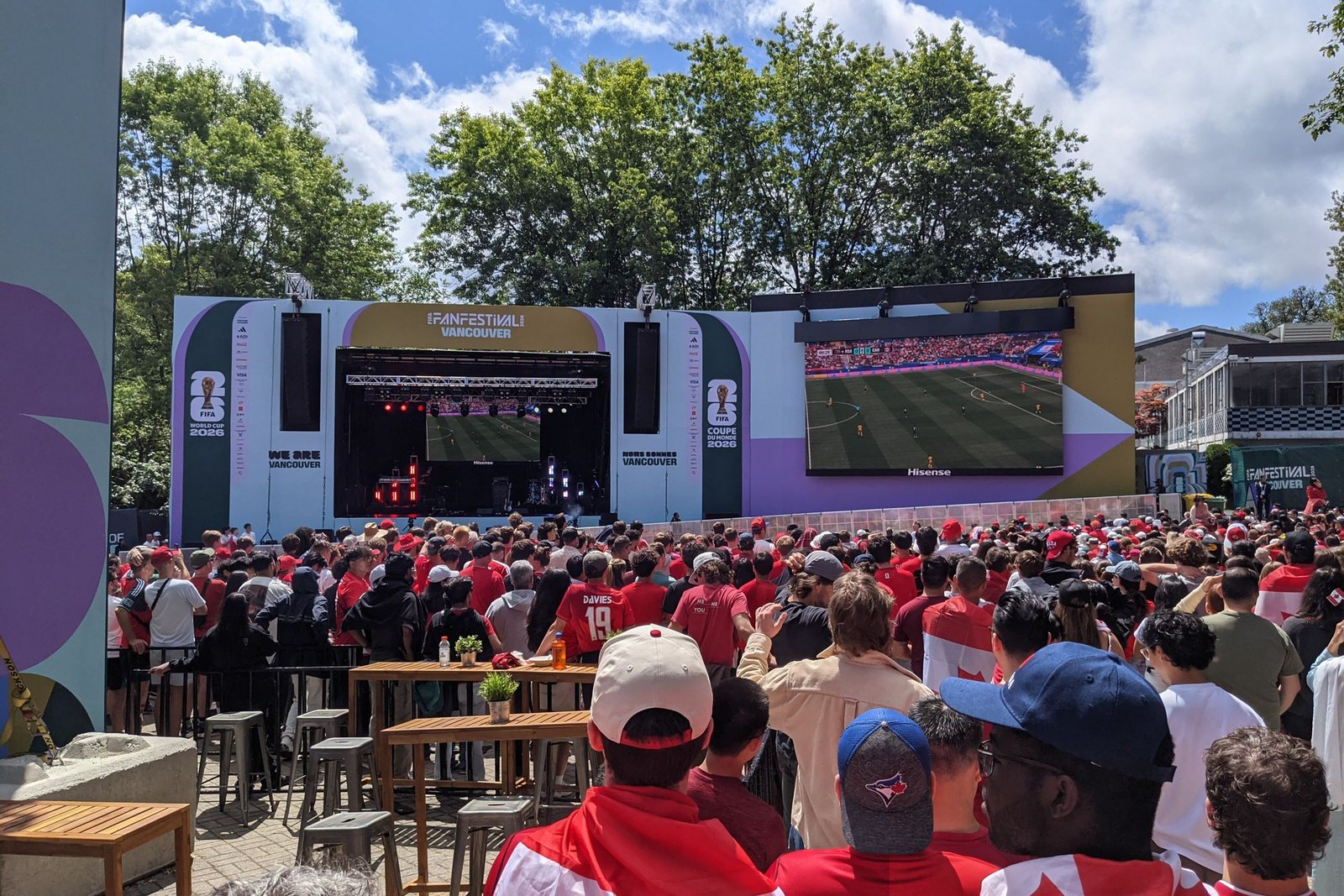
The same screens already carry civic content in North America. The FBI and the outdoor-advertising industry run public-safety alerts across more than 10,000 digital screens, with more than 28,000 tips reported. Times Square's Midnight Moment turns more than 90 screens into a single artwork every night. In Montréal, the Quartier des Spectacles has used projection and architectural light since 2006 to mark a district as a place of culture. And in Vancouver in summer 2026, the FIFA Fan Festival — built around giant screens — recorded 502,157 visits in its first 25 days.
Two cautions belong here. Most of the measured effects come from interactive, often research-run installations, not from the advertising-funded networks that now make up most outdoor screens. And the industry figures above are self-reported.
Why the expensive projects failed
Three cases come up whenever digital cities are discussed.
LinkNYC. New York's advertising-funded kiosk network was projected to return more than US$500 million to the city over twelve years. A 2021 audit by the New York State Comptroller found kiosks in fewer than half of the city's ZIP codes and US$68.9 million owed to the city. Privacy advocates later reported that device identifiers had not been anonymised as promised.
Quayside, Toronto. Sidewalk Labs withdrew from its waterfront project in May 2020, citing economic uncertainty, after two years of public dispute over who would control the data.
The Line, NEOM. Announced as a 170-kilometre linear city for nine million people, it has been paused and redesigned; reporting in 2025 and 2026 describes halted construction and a shift to a phased, demand-led approach. It has not been officially cancelled.
None of these failed because the technology did not work. They failed on finance, governance and trust — because the technology came first and the people who would live with it came last. The classical critics are right about these projects. They are right for a reason that points somewhere other than "no screens".
Light, safety and privacy
The case against screens is not only aesthetic, and the strongest parts of it deserve a direct answer.
Driver distraction. The evidence is contested. In an on-road study of 41 drivers in Sweden, Tania Dukic and colleagues found that electronic billboards drew more and longer glances than other roadside objects — a mean daytime dwell of 2.25 seconds, against 0.87 seconds for traffic signs. A study on a Massachusetts highway also found measurable shifts in glance behaviour. A study for the U.S. Federal Highway Administration reported that the longest glances stayed below the commonly used two-second threshold; the industry cites it, and its critics dispute it. The practical conclusion is the same either way: keep dynamic screens away from high-speed, high-workload roads.
Light. Vancouver's Sign By-law permits electronic signs only where specifically allowed, and caps their brightness at 300 nits from sunset to sunrise and 5,000 nits during the day, with separate rules for the Granville Street sign district.
Roads. British Columbia prohibits digital and projected advertising displays inside provincial highway rights-of-way.
Privacy. Federal and provincial private-sector privacy law applies whenever audience measurement uses personal information. After LinkNYC and Quayside, the sensible default is to collect no personal data at all and to publish what is and is not measured.
These rules already favour operators who work responsibly. The question is whether the industry treats them as a ceiling to push against or a floor to build on.
The screens are coming either way
Outdoor media is already mostly digital. In Canada, out-of-home advertising revenue reached C$842 million in 2025, of which C$492 million — 58%, up from 55% the year before — came from digital formats. In the United States, revenue reached a record US$9.46 billion, with digital formats accounting for 36.3% and growing by 10.5%.
That changes the question. Screens will be installed whether or not architects and communities take part. If they stay out, advertisers and platforms will decide alone what the screens show, where they stand and whom they serve.
Pop-up cities and participatory communities
Some of the most interesting experiments are temporary. Zuzalu, convened by Vitalik Buterin in Montenegro in 2023, gathered around 200 core residents for two months around shared interests in technology, longevity and public goods; Buterin later acknowledged that two months and two hundred people were too little to test durable governance. Its successor gatherings include Edge City's Edge Esmeralda in Healdsburg, California, whose third edition ran from May to June 2026 with roughly 500 participants and is framed as a prototype for a permanent walkable town.
These are temporary cities in a literal sense. From the first day they need wayfinding, schedules, announcements and a shared notice-board — exactly the layer that modular screens and community-curated content provide.
Japan's Society 5.0 policy describes a human-centred society that integrates physical and digital space. "Society 6.0" appears in some writing on participatory, well-being-centred communities, but it has no agreed definition and is best treated as a working label.
Verified-membership platforms offer one practical governance option. NODA, where this article is published, records contributions from verified members and settles payments outside the platform; it states plainly that it is not an investment fund or token scheme. A platform of that kind could propose, check and credit the community content that appears on public screens.
Four layers, not one
The traditions read better as layers than as rivals. Each adds to the one beneath it; none replaces it.
- Fabric — the city as artefact. Screens are sited, scaled and lit as part of the architecture. Supplies aesthetics.
- Life — the city as stage. Shared events, public art, something to gather around. Supplies social offerings.
- Interface — the city as platform. Transit information, alerts, wayfinding, media façades. Supports social offerings.
- Community — the city as commons. Community-curated content, consultation, recognition of who contributed. Supplies openness.
Translated into design practice, the classical vocabulary survives intact:
- Dynamic legibility (after Lynch). A screen can act as a temporary node or landmark. It cannot repair an illegible plan.
- Serial vision in time (after Cullen). Content can be sequenced along a walking route, so that information and art unfold with movement.
- Digital patterns (after Alexander). A "civic window" — an eye-level screen paired with seating and a notice-board — can be specified as a recurring pattern rather than a one-off installation.
- Programmed life between buildings (after Gehl and Whyte). Eye-level, low-brightness, interactive formats that invite people to linger — not large broadcast loops.
- Digital genius loci (after Norberg-Schulz). Content drawn from local histories, languages and communities. Generic content is what produces the "placelessness" Edward Relph warned about; the medium is not the problem.
Answering the classical objections
- "Screens destroy the spirit of place." Genius loci is perceived meaning. Locally curated content can strengthen it, as Montréal shows. Generic content weakens it — and that is a choice about content, not about the medium.
- "Legibility comes from form." Agreed. Digital wayfinding can extend a legible plan; it cannot rescue an illegible one.
- "It is only advertising." Advertising already funds public-safety alerts, public art and transit information on the same screens. A fixed, published share of screen time for civic content answers the concern directly.
- "Smart cities fail." They do when technology comes before governance. The proposal here reverses the order: architecture and community first, technology as a modular, removable and governed layer.
- "Light pollution and road safety." Meet the limits and stay below them: ambient dimming, night-time caps, static dwell times and no screens on high-speed roads.
What this means for Vancouver
Vancouver's planning identity — slender towers on podiums, active street walls, protected view corridors and a continuous seawall — is a form-centred success. Its next chapter is about programming the public realm it has already built.
Three conditions make the city well placed. Its regulation already constrains brightness and siting. Its temporary plaza programme, VIVA Vancouver, shows an institutional appetite for reconfigurable, tactical interventions. And the 2026 fan festival showed public demand for shared, screen-centred gatherings — which raises the question of what should continue as legacy.
A workable set of principles:
- A civic-content share. A fixed, published share of screen time for community, cultural, emergency and transit content.
- A local-content floor. A minimum share of locally produced or locally relevant material, including multilingual and diaspora content.
- Light by design. Ambient dimming and night-time levels at or below the by-law caps, with screens at pedestrian scale.
- Privacy by design. No personal data collected, anonymisation at the device, and published data practices.
- Community curation. Content proposed, verified and credited through accountable community structures, with editorial rules made public.
- Design-stage integration. Power, sightlines, brightness and heritage fit resolved by architects at design stage, not retrofitted.
What the evidence does not show
It does not show that advertising-funded screen networks make public space more sociable. That has hardly been studied with the methods Whyte and Gehl used — before-and-after observation, dwell times, attachment surveys — and it should be. The research on roadside digital billboards and driver distraction is genuinely contested. Several of the figures above come from industry or press reporting and may be revised. And the field studies cited were run at specific sites with specific populations; their effects may not transfer to Vancouver.
None of this makes a screen the answer to a badly designed square. A city still needs its body. The argument is only that its body is not the whole of it.
What comes next
The most useful next step is small and measurable: one pilot on one Vancouver public space, studied properly. That means behavioural mapping before and after, dwell-time counts, and a short attachment survey adapted from the Soul of the Community questions — the kind of evidence that is currently missing.
To frame it, a forum titled Future Cities: Form, Content, and Community is being proposed for Vancouver in 2027 — a conversation between architects, communities and the people who operate screens, open to planners, artists, universities and the City. Indicative sessions would cover whether form still makes the city, the evidence on place attachment, screens as civic infrastructure, lessons from failed digital projects, pop-up and participatory communities, and a design charrette for a civic-window prototype. Members who want to take part can say so through NODA.
Disclosure: the author is chief executive of Totemian Brandboards, a Vancouver digital out-of-home network, and is involved with NODA.
References
Selected; the full list is in the working paper.
- Asgharian, H. (2026). Form, content, and community: Digital layers, urban screens and the making of place in future cities (Working Paper v1.0). Totemian Brandboards Inc.
- Belyusar, D., Reimer, B., Mehler, B., & Coughlin, J. F. (2016). A field study on the effects of digital billboards on glance behavior during highway driving. Accident Analysis & Prevention, 88, 88–96. doi:10.1016/j.aap.2015.12.014
- Brignull, H., & Rogers, Y. (2003). Enticing people to interact with large public displays in public spaces. Proceedings of INTERACT '03, 17–24.
- Buterin, V. (2023). Why I built Zuzalu. Palladium.
- Castells, M. (1996). The rise of the network society. Blackwell.
- City of Vancouver. (2026). Sign By-law No. 11879. bylaws.vancouver.ca
- COMMB. (2026). First-ever Canadian out-of-home industry revenue reporting. Canadian Out-of-Home Marketing and Measurement Bureau.
- de Waal, M. (2014). The city as interface: How new media are changing the city. nai010 publishers.
- Dukic, T., Ahlstrom, C., Patten, C., Kettwich, C., & Kircher, K. (2013). Effects of electronic billboards on driver distraction. Traffic Injury Prevention, 14(5), 469–476. doi:10.1080/15389588.2012.731546
- Fischer, P. T., & Hornecker, E. (2012). Urban HCI: Spatial aspects in the design of shared encounters for media facades. Proceedings of CHI '12, 307–316. doi:10.1145/2207676.2207719
- Gehl, J. (2010). Cities for people. Island Press.
- Greenfield, A. (2013). Against the smart city. Do Projects.
- Jacobs, J. (1961). The death and life of great American cities. Random House.
- Knight Foundation. (2010). Knight Soul of the Community 2010: Why people love where they live and why it matters. John S. and James L. Knight Foundation & Gallup.
- Lydon, M., & Garcia, A. (2015). Tactical urbanism: Short-term action for long-term change. Island Press.
- Lynch, K. (1960). The image of the city. MIT Press.
- Manovich, L. (2006). The poetics of augmented space. Visual Communication, 5(2), 219–240. doi:10.1177/1470357206065527
- Mattern, S. (2021). A city is not a computer: Other urban intelligences. Princeton University Press.
- McKinsey Global Institute. (2018). Smart cities: Digital solutions for a more livable future. McKinsey & Company.
- McQuire, S. (2010). Rethinking media events: Large screens, public space broadcasting and beyond. New Media & Society, 12(4), 567–582. doi:10.1177/1461444809342764
- Memarovic, N., Langheinrich, M., & Alt, F. (2012). The Interacting Places Framework. Proceedings of PerDis '12. doi:10.1145/2307798.2307805
- Moreno, C., Allam, Z., Chabaud, D., Gall, C., & Pratlong, F. (2021). Introducing the "15-minute city". Smart Cities, 4(1), 93–111. doi:10.3390/smartcities4010006
- Müller, J., Eberle, D., & Tollmar, K. (2014). Communiplay: A field study of a public display mediaspace. Proceedings of CHI '14, 1415–1424. doi:10.1145/2556288.2557001
- Norberg-Schulz, C. (1980). Genius loci: Towards a phenomenology of architecture. Rizzoli.
- OAAA. (2026). Out of home advertising revenue reaches record $9.46 billion. Out of Home Advertising Association of America.
- Office of the New York State Comptroller. (2021, July 30). DiNapoli examines faltering LinkNYC program [Press release]. osc.ny.gov
- Peltonen, P., et al. (2008). "It's mine, don't touch!": Interactions at a large multi-touch display in a city centre. Proceedings of CHI '08, 1285–1294. doi:10.1145/1357054.1357255
- Pine, B. J., & Gilmore, J. H. (1998). Welcome to the experience economy. Harvard Business Review, 76(4), 97–105.
- Relph, E. (1976). Place and placelessness. Pion.
- Sennett, R. (2018). Building and dwelling: Ethics for the city. Farrar, Straus and Giroux.
- Struppek, M. (2006). The social potential of urban screens. Visual Communication, 5(2), 173–188. doi:10.1177/1470357206065333
- Whyte, W. H. (1980). The social life of small urban spaces. Conservation Foundation.